A tour of my Bangkok condo balcony: plants, guppies and teak wood finds..
Living in a condo in central Bangkok doesn't necessarily mean giving up on outdoor space. My condo actually has two balcony areas, and while neither is particularly large or blessed with spectacular views, I've gradually filled them with plants, decorative pots, wooden furnishings and even a small ecosystem of guppies.
Here's a tour of both balconies and some of the things I've collected to make these small outdoor spaces feel a little more like home.
The main balcony is the larger of the two and wraps around part of the condo.
One of the first things you notice is a stack of three air-conditioning units positioned at the very edge. I've seen other condos where people build cages, screens or enclosures around their air-conditioning units, and I think something like that could make this area look a little neater. It could also provide somewhere to hide the cleaning equipment that currently gets stashed down the side.
It's something I might consider in the future, although I don't think the air-conditioning units look bad enough to make it a priority.
The metal railing runs around the balcony and could probably do with a fresh coat of paint. Along it, I've added plenty of plants to bring some greenery to what would otherwise be a fairly plain outdoor space.
Because Bangkok can experience strong winds and heavy rain during the rainy season, some of the plastic plant pots are tied securely to the metal railing. It's a simple solution, but it prevents lightweight pots from being blown around when the wind picks up.
Most of the plants I've chosen are deliberately low maintenance. They don't need much direct sunlight and can survive without constant watering, which makes them particularly well suited to a covered condo balcony.
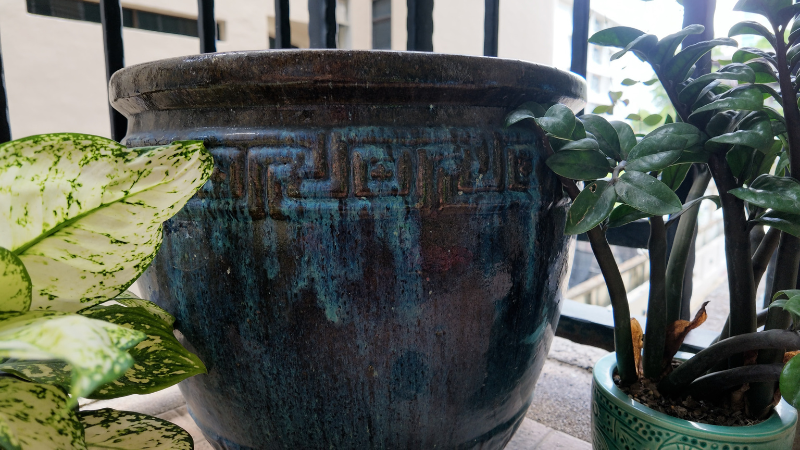
My favourite thing on the entire balcony is a large blue ceramic pot filled with water and around two dozen guppies.
Feeding the fish has become part of my morning routine, and it's something that brings me a surprising amount of joy.
The pot contains more than just fish. There are aquatic plants, rocks and snails, creating a miniature ecosystem. The snails help with the natural cleaning process, while the guppies reproduce on their own.
One concern people might have about keeping a large container of water outdoors in Bangkok is mosquitoes. However, I've found that the guppies make an effective form of mosquito control. Any small insects or larvae in the water quickly become a natural source of food for the fish.
The result is a fascinating little ecosystem that requires relatively little intervention.
Guppies are also inexpensive and widely available in Bangkok. You can find them in pet shops and at markets such as Chatuchak for around 10 baht each.
If you're setting up something similar, it's important not to simply fill a pot with fresh tap water and immediately add the fish. I leave the water standing before introducing them so that it is suitable for the fish.
The blue ceramic pot itself has an interesting story.
I bought it from a Vietnamese restaurant near my condo in Bangkok. The restaurant has a garden area filled with various decorative pots and plants, including some much larger pieces.
This particular pot is roughly 40 to 50 centimetres tall and around 40 centimetres in diameter.
I remember thinking it was quite expensive when I first heard the price. I'm certainly no expert when it comes to ceramic pots, but I liked it enough to buy it anyway. It cost approximately 4,000 baht, or around £100.
It might have been more than I expected to spend on a garden pot, but I've had a lot of enjoyment from it. Between the design of the pot itself and the little community of fish living inside, it has become the centrepiece of the balcony.
Another of my favourite decorative pieces is a hand-carved horse made from teak wood.
It doesn't serve any practical purpose, but not everything in a home needs to. Sometimes it's simply nice to have an object because you enjoy looking at it.
I found the horse at a market near the border between Prachuap Khiri Khan province and Myanmar, around an hour's drive from Hua Hin.
The market has a huge selection of wooden carvings, furniture and home furnishings. The horse cost around 1,000 baht, which I thought was excellent value considering the craftsmanship.
The proportions and details of the carving are remarkably good, and it adds a little character to the balcony among all the plants.
Much of the remaining space is occupied by small outdoor plants in an assortment of pots.
I occasionally add used coffee grounds or eggshells to the soil as a simple way of adding organic material. More importantly, I've tried to choose plants that are suitable for the conditions on the balcony.
Direct sunlight is limited, so plants that require hours of strong sunshine every day aren't particularly practical here.
The covered balcony also means the plants don't receive much rain naturally, so they still need to be watered manually.
There's another balcony around the corner, but because the two sections aren't directly connected, you have to walk back through the condo to reach it.
The second balcony is considerably narrower, although there's still enough room for a surprisingly large collection of plants.
The biggest challenge here is sunlight.
Looking directly across from the balcony, there's another huge building blocking much of the view and most of the natural light. There's only a relatively small opening where the sun can get through.
For an hour or two each morning, sunlight reaches the balcony and gives the plants some much-needed light. For the rest of the day, they're largely in the shade.
This means plant selection is particularly important. I've tried to choose varieties that can thrive in low-light or overcast conditions without requiring excessive amounts of water.
I generally water them every two or three days, which seems to work well.
One thing I've learned is that you can spend almost any amount of money on plant pots.
Some decorative ceramic pots can be surprisingly expensive, while basic alternatives are readily available online or from local garden centres for very little money.
The balcony has a mixture of both.
Alongside the more expensive ceramic pots, I have a small teak wood stool that came from the same market near the Myanmar border where I found the carved horse.
The stool cost only around 100 baht.
It's another reminder that interesting home furnishings don't necessarily need to be expensive. Markets around Thailand can be great places to find locally made furniture, carvings and decorative pieces at reasonable prices.
I'd like to return to this particular market in the future and explore it properly, as it could make an interesting At Home In Asia video in its own right.
The second balcony has a mixture of cacti, aloe vera and other houseplants.
Even the cacti don't receive much direct sunlight, but they also don't require much water and so far seem to be doing reasonably well.
One of the larger plants sits inside another substantial decorative pot that I bought from the same Vietnamese restaurant as the blue fish pot. It was slightly cheaper, although I still remember thinking it was fairly expensive at the time.
Nevertheless, I like the colour and size of the pot, and it provides a good visual base for the larger plant.
There are also hanging plants and pots attached directly to the balcony railing. Again, anything lightweight needs to be secured properly so that it can't fall or blow away.
Keeping a balcony filled with plants is relatively easy, but it isn't completely maintenance-free.
Most of mine only need watering every two or three days. However, if I'm away from Bangkok for an extended period, I need someone who can come in and water them.
Keeping fish adds another responsibility. While the guppies are remarkably self-sufficient, they still need someone to check on them and make sure everything is okay when I'm away.
There's also the reality of living in central Bangkok.
My balcony isn't a peaceful tropical retreat overlooking rice fields or mountains. Cars, motorcycles and tuk-tuks are constantly moving through the streets below, and the traffic can be noisy.
You eventually get used to much of the background noise, although there are certainly times when it can become annoying.
The views are restricted and the amount of direct sunlight is limited, but despite all of that, I still enjoy stepping outside onto the balcony every day.
For me, that's really the point.
A condo balcony doesn't have to be huge or have an incredible view to be enjoyable. With some carefully selected plants, interesting pots and a few personal touches collected on travels around Thailand and Southeast Asia, even a small urban balcony can become an enjoyable extension of your home.
And in my case, a pot filled with two dozen guppies has turned out to be one of the simplest—and most enjoyable—additions of all.

No bio available.
All Rights Reserved © 2026