Dusit Thani Pattaya room and garden tour: old-fashioned charm in one of Pattaya’s best locations..
The Dusit Thani Pattaya is one of those hotels that makes a strong argument for not always choosing the newest property available.
First opened in the 1980s, the hotel is noticeably from another era. The rooms are large, there's extensive use of real wood, carpets and wallpaper, and the sprawling gardens occupy a beachfront site that would be difficult to replicate with a new hotel today.
There are signs of age, however. During my stay in a one-bedroom suite, I found worn furniture, marked wallpaper, tired carpets and some areas where cleaning and maintenance could certainly be improved.
Yet I still really like the Dusit Thani Pattaya. The reason becomes obvious when you walk outside.
My room was a one-bedroom suite on the second floor, starting with a separate living area containing a sofa, armchair, coffee table and large television.
There's also a minibar and tea and coffee facilities tucked into the corner.
It's a useful space rather than simply somewhere designed to look impressive. After spending the day around Pattaya or by the pool, having a separate living room gives you somewhere to sit without spending the evening on the bed.
That extra space continues throughout the suite.
A corridor leading towards the bedroom has an unusually long floor-to-ceiling mirror running along one wall, while the other side provides access to the bathroom.
The bathroom is another reminder of the benefits of staying in an older hotel.
There's a full-size bathtub with a shower, a separate walk-in shower, a large basin with a wooden vanity and a partially enclosed toilet.
It isn't an especially contemporary bathroom, but there's a tremendous amount of space.
The walk-in shower also performs where it matters: plenty of hot water and good water pressure.
Sliding wooden and frosted-glass doors separate the different parts of the suite. I particularly like these, including the brass fittings and use of actual wood. They're details that give the room considerably more warmth than the painted walls and composite materials often found in newer hotels.
Continue along the corridor and there's a dedicated walk-in wardrobe.
Again, it's enormous by modern hotel-room standards.
There's room for suitcases, hanging clothes and shoes, along with numerous cupboards and drawers. The hotel provides dressing gowns, a safe, hairdryer, umbrella and even a shoe brush.
For a stay of a couple of nights, much of this storage is unnecessary. For somebody staying for several weeks, however, it would be extremely useful.
The main bedroom continues the traditional aesthetic.
The colour palette consists largely of bronze, silver, cream, brown and gold. There's a soft carpet underfoot, wooden furniture, wooden wall panels and wallpaper throughout much of the room.
Behind the beds is a backlit canvas featuring lotus plants, while the padded headboards continue the metallic bronze and silver theme.
There's another television opposite the beds and, importantly for anyone who needs to work during their stay, a proper desk with a large comfortable chair.
I much prefer this kind of hotel bedroom to some contemporary designs.
Modern hotels can sometimes become almost clinical in their determination to use hard surfaces and easily maintained materials. The Dusit Thani feels warmer. Carpet, wallpaper and wood aren't necessarily the easiest materials for a hotel to maintain, but they make the room feel more comfortable.
Unfortunately, that leads to one of the hotel's biggest problems.
Look closely and there's quite a lot of wear and tear.
Some of the wooden furniture has chips and marks. Sections of wallpaper are stained or beginning to peel, and wallpaper inevitably makes fingerprints and other marks particularly noticeable.
The carpet is also starting to thread in places.
I wasn't particularly impressed by some of the lamps either. One felt unstable, while the design and materials didn't really match what I would expect from an upper-upscale hotel.
There were also areas where dust was visible, including behind furniture and fittings.
These aren't necessarily reasons to avoid the hotel, but they matter when a property is charging premium prices. There's a difference between preserving the character of an older hotel and simply allowing furnishings to become tired.
I'd much rather see the Dusit Thani retain this style while investing more heavily in refurbishment, deep cleaning and maintenance than replace everything with a generic modern interior.
The balcony demonstrates just how good the hotel's position is.
My suite was only on the second floor — about as low as you can get — yet I could still see the sea.
The balcony itself is reasonably spacious and includes a sun lounger, although the lounger during my stay was one item that clearly needed replacing. It was dirty, damaged and showing signs of mould.
The building immediately outside the room houses the hotel's fitness centre, an addition made after the original hotel was constructed.
But the real attraction lies beyond it.
Walk outside and the Dusit Thani starts to make much more sense.
The grounds are spacious, green and remarkably relaxing considering you're staying in Pattaya.
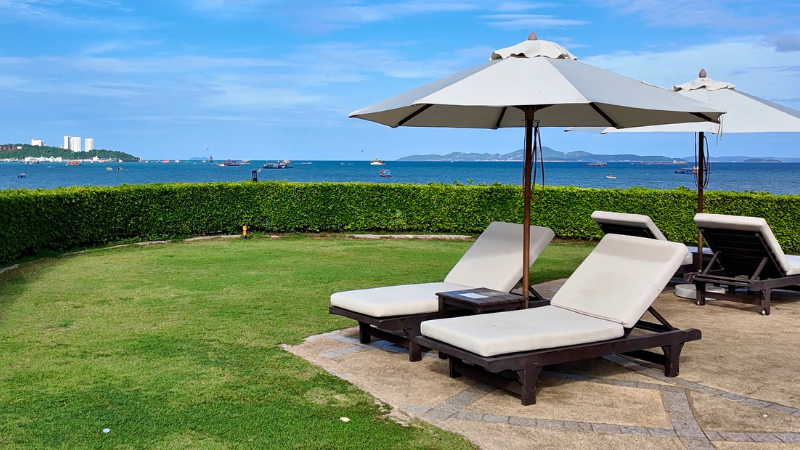
Lawns, mature tropical plants, swimming pools and sun loungers extend towards the sea. Rather than feeling like a hotel squeezed onto an expensive urban plot, it feels like a genuine resort.
You can sit on a sun lounger overlooking Pattaya Bay, with boats crossing the water and Koh Larn visible in the distance.
It's a completely different side of Pattaya from the traffic, shopping centres, bars and nightlife only a short distance away.
And this is where the age of the hotel arguably becomes an advantage.
The Dusit Thani occupies a substantial site at the northern end of Pattaya Beach.
Its location gives it direct access to the beach as well as panoramic views across Pattaya Bay. In my opinion, it's one of the best hotel locations in the city.
A modern developer looking at such valuable beachfront land would presumably face enormous pressure to maximise the number of rooms and the revenue generated from every square metre.
That's why older hotels can sometimes offer something newer properties can't: space.
The bedrooms are bigger. The bathrooms are bigger. There are large balconies, extensive gardens and generous communal areas.
Not every square metre has been monetised.
That's ultimately the question with the Dusit Thani Pattaya.
If your priority is having the newest room, immaculate contemporary furnishings and the latest interior-design trends, there are newer hotels in Pattaya that will probably suit you better.
The Dusit Thani rooms need investment in places. Some furnishings should be replaced, maintenance needs more attention and certain areas would benefit from a thorough deep clean.
But I wouldn't want to see the character removed in the process.
The wood, carpets, wallpaper, large bathrooms and generous bedrooms are precisely what distinguish the property from newer hotels filled with hard floors and minimalist furniture.
There's a warmth to it that I like.
For me, yes — but primarily because of the location, gardens and sheer amount of space.
The room itself is comfortable and unusually large, but it's not flawless. At upper-upscale prices, I'd expect a better standard of maintenance.
Once you're outside, however, those complaints become easier to forgive.
Sitting in a tropical garden looking directly across Pattaya Beach is a compelling reminder of why this hotel has survived for decades.
The Dusit Thani Pattaya doesn't need to become a brand-new hotel.
It just needs enough care and investment to ensure that being old-fashioned remains part of its charm rather than becoming simply old.

No bio available.
All Rights Reserved © 2026